×

The Standard e-Paper
Join Thousands of Readers





Audio By Vocalize
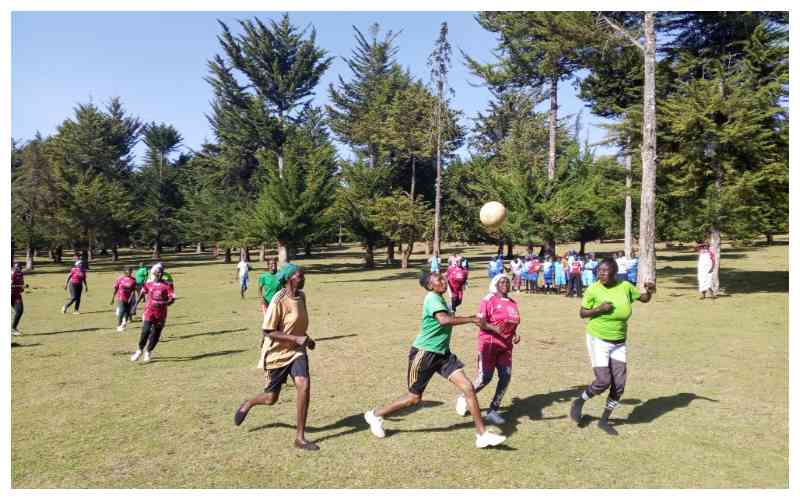
The high-pitched laughter of elderly women pierces the calm afternoon air at the edge of Kaptagat Forest in Elgeyo Marakwet County.
One after another, they emerge from different footpaths carrying football jerseys, a few pairs of worn-out boots and, for some, nothing more than bare feet.
On paper, most of them are over 60 years old. In motion, however, advanced age becomes almost impossible to believe.
Within minutes, the women transform into footballers. Jerseys replace sweaters, warm greetings give way to whistles, and the dusty clearing at the edge of the forest bursts into activity.
They showcase clever dribbles and perfectly timed tackles beneath towering trees, creating a scene more reminiscent of a competitive league than a gathering of grandmothers.
Kaptagat, which is known for producing world-class athletes in training camps such as Complete Sports, Global Sports Communication, Rosa Associati and Pace Sports among others, is their new grannies football base.
Christine Kiptanui, 69, weaves through defenders before calmly finding the back of the net. A loud cheer erupts from her teammates.
The Tendwa Grannies player says football has become medicine.
"We are kicking out high blood pressure and arthritis," she says.
"Training does not stop me from taking care of my family. I still cook for my husband and other family members because I have learned how to balance football and household responsibilities."
Beyond the game itself, she says, the women have created a support network.
"We don't only meet to play football. We also interact and exchange ideas on how to manage the challenges that come with old age."
For 70-year-old Truphena Chepseba, football has opened doors she never imagined would exist in her later years.
"I have been a granny footballer for the last two years, and the sport has taken me to places I had never been before," says Chepseba.
Last year, she travelled from Elgeyo Marakwet to Chepareria in West Pokot County, where her team defeated Kapkangani Grannies from Nandi County 2-0.
"We want to travel even farther to play football, but first we want this ecosystem protected. The fencing project does not stop us from training. Instead, it keeps illegal activities away," she adds.
Playing football inside the forest has transformed my health too, says Ms Chepseba.
"Initially, I was battling knee pain because of old age and could barely walk around. I stayed at home most of the time. Today, I am fit because of granny football. I even look younger than some of my peers who don't play," she says.
But grannies football is only half of their story.
These women, drawn from Chepkosom, Tendwa, Kapkukto/Sabor and Kimore grannies football teams, have become unlikely conservationists of the 20,000-hectare Kaptagat Forest ecosystem—a vital water tower that supplies Iten, Tambach, the drought-prone Kerio Valley and neighbouring Eldoret in Uasin Gishu County.
As government agencies intensify efforts to fence the forest and shield it from illegal logging, charcoal burning and overgrazing, the grannies say their football has become another line of defence.
"Through football, we police the forest and ensure that no one destroys it. It is our resource, and we will not allow degradation," says 65-year-old grannies footballer Rosalina Kiplagat before joining her teammates for warm-up drills.
Kiplagat says the women fully support the ongoing conservation programme spearheaded by the government through the Kenya Forest Service (KFS) in partnership with organisations such as Kaptagat Integrated Conservation Programme because their lives and livelihoods are closely tied to the forest.
"We don't have a modern football pitch, but the playground in Kaptagat Forest helps us prepare for competitions. We hope the government will find a way for us to continue playing inside the ecosystem even after the fencing project is complete. Playing inside the forest is ideal because there is no interference," she says.
For Mary Maiyo of Kimore Grannies, every training session is also an environmental mission.
"We grow trees as we play football inside Kaptagat Forest. Playing in the forest refreshes my mind and helps me fight stress," she says.
Training three times a week; every Tuesday, Thursday and Saturday has become part of her routine.
"I have learned discipline through football. We only request potential partners to empower us with proper football kits and modern playgrounds along the edge of the forest," says Maiyo.
Kenya Grannies Football technical coach David Wanyu says the sport was established only a year ago by federation president Elizabeth Keitany to improve the health and well-being of elderly women through sport.
"Many elderly women were battling backaches, arthritis, diabetes and high blood pressure, but football has helped them become healthier," Wanyu says.
Their biggest challenge, however, remains the lack of proper training facilities.
"Most playgrounds in nearby schools are occupied by students preparing for competitions, making it difficult for the grannies to train consistently," the coach says.
Even so, bigger dreams are already taking shape. Some teams hope to travel to France later this year for an international tournament, if they secure financial support.
Others, the technical official said, have received invitations from teams in the United States, although many players cannot yet afford passports.
Before those international dreams can become reality, the women will lace up once again closer to home when they participate in the Mazingira Day tournament in Makueni on October 10.
For these remarkable grandmothers, every kick of the ball carries a double purpose.
They are chasing fitness, friendship and fresh adventures while standing guard over one of Kenya's most important forests—proving that conservation can flourish in the most unexpected of playing fields.
Subscribe to our newsletter and stay updated on the latest developments and special offers!