×

The Standard e-Paper
Read Offline Anywhere





Audio By Vocalize
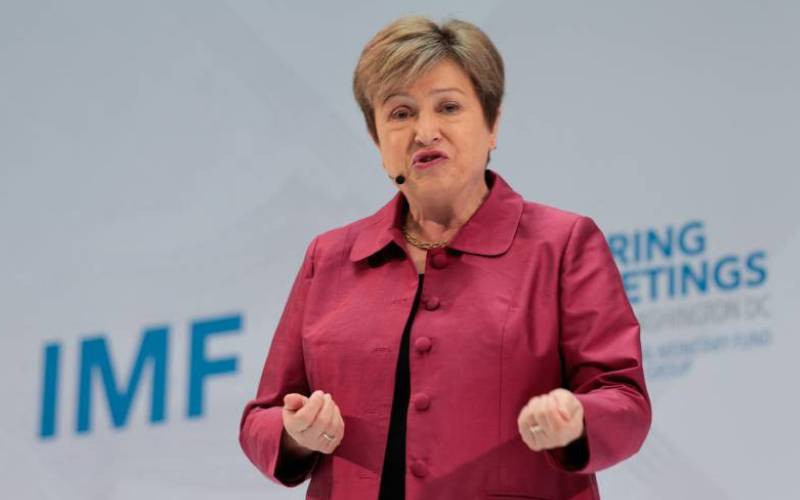
IMF managing director Kristalina Georgieva at IMF headquarters in Washington, DC, on April 9, 2026. [AFP]
The International Monetary Fund (IMF) has warned that escalating economic pressures from the conflict in the Middle East could trigger a fresh wave of social unrest across vulnerable nations such as Kenya.
The dire warning comes even as President William Ruto’s government struggles to contain mounting public anger over record fuel prices, which have triggered fears of a fresh squeeze on already dwindling household incomes.
In a statement issued after the African Consultative Group meeting in Washington, IMF Managing Director Kristalina Georgieva and African Caucus Chairman Seedy Keita said the war in the Middle East — even if a recent ceasefire holds — will weigh on global growth and add a “layer of complexity” for African economies like Kenya, already burdened by high debt and limited fiscal space.
The African Consultative Group is a forum comprising finance ministers and central bank governors from a subset of 12 African countries, including Kenya and IMF management.
It was formed in 2007 to enhance global policy dialogue. They meet annually during the IMF Spring Meetings held in Washington DC to discuss the continent’s economic outlook, growth reforms, and financial stability.
“The war adds another layer of complexity, with the potential for severe scarring, including from the return of inflation, food shortages, as well as other social tensions,” the joint statement by the IMF and the pan-African forum read.
The warning on return of social tensions revives a familiar refrain from the Fund, which has repeatedly cautioned that economic shocks — from the Covid-19 pandemic to the Ukraine war — can quickly translate into street protests when governments fail to protect the most vulnerable. Georgieva explicitly warned that the protests seen in Sri Lanka in 2022 could be repeated elsewhere if countries did not cushion the poor from rising food and fuel prices.
Now, with the Iran conflict sending global oil prices above $100 a barrel and disrupting shipping through the Strait of Hormuz, the Fund is sounding the alarm again.
For Kenya, the IMF’s warning is uncomfortably familiar. The country is still grappling with the aftermath of deadly protests in 2024, when the government’s push for new IMF-backed tax measures sparked nationwide demonstrations led mainly by young people or Gen Z, which rights groups say left more than two dozen people dead.
That explosion of public anger was fuelled by years of rising living costs, subsidy cuts, and austerity measures imposed under successive IMF programmes. Now, history appears to be repeating itself.
On Wednesday, Kenya’s Energy and Petroleum Regulatory Authority (Epra) raised maximum retail prices for super petrol by Sh28.69 per litre and diesel by Sh40.30 — the highest levels in the country’s history.
The hike, effective April 15, triggered immediate public outcry across the country and forced President Ruto to announce a surprise three-month cut in value-added tax on fuel from 16 per cent to eight per cent.
The tax cut, announced during a public rally in Kisii, was deeper than the 13 per cent rate the energy regulator had flagged just a day earlier.
It came as the government tapped the Petroleum Development Levy Fund for Sh6.2 billion to stabilise prices.
Yet analysts say the move, while offering temporary relief, exposes the fragility of Kenya’s public finances. The Kenya Revenue Authority missed its nine-month tax target by Sh84 billion as of March.
Interest payments on public debt, which has crossed Sh12.8 trillion, are projected to consume Sh1.66 trillion in the coming financial year —nearly 40 per cent of ordinary revenue.
United Opposition leaders led by Wiper Party’s Kalonzo Musyoka, DCP leader Rigathi Gachagua, and former Interior CS Fred Matiang’i on Wednesday threatened to call mass protests unless the government reverses the record-high fuel prices, warning that Kenyans would take to the streets within days.
At a press conference in Nairobi, the coalition demanded President Ruto convene a special sitting of Parliament within seven days to address the deepening crisis, and issued a blunt ultimatum.
“Failure to which the United Opposition shall call for national mass action,” said Gachagua, reading a joint statement. The leaders accused the government of irregularities in the petroleum importation procedures under the Government-to-Government framework and demanded its immediate cancellation.
Gachagua had earlier warned: “If you dare to increase the cost of petrol, diesel or kerosene, we will tell Kenyans to go to the streets to ask you to go home.”
Ruto, however, has dismissed the protest threats, saying during a tour of the Gusii region: “Some people are saying that because prices have gone up, they want to protest. If you protest, will the prices come down?”
The threats mirror scenes elsewhere on the continent and beyond, where surging pump prices have already ignited public anger.
In the Philippines, jeepney drivers launched a three-day nationwide strike on Wednesday, demanding a rollback in oil prices and the removal of fuel taxes, with one transport federation estimating around 80,000 members participating in the protest.
The fallout of the Iran war is already visible in Kenya’s real economy. The Stanbic Bank Kenya Purchasing Managers’ Index (PMI) fell to 47.7 in March from 50.4 in February, ending six consecutive months of expansion. It was the first contraction since August 2025.
Businesses reported “constrained customer spending, reduced cash circulation and tighter household budgets” as the main drag on activity. New orders fell solidly for the first time in seven months, and firms were largely unable to pass higher input costs onto customers, with only four per cent of respondents raising their charges.
“A weaker Stanbic Kenya PMI in March reflects demand-side concerns — softer spending power constraining demand — and supply-side concerns about the war in the Middle East,” said Christopher Legilisho, economist at Standard Bank.
Inflation data tells a similar story. While headline inflation edged up marginally to 4.4 per cent in March, non-core inflation – which strips out stable prices to focus on volatile food and energy costs – surged to 10.8 per cent, up from 10.1 per cent in February.
Tomato prices jumped 13.3 per cent in a single month, and beef with bones rose 1.8 per cent.
The Central Bank of Kenya last week slashed its 2026 growth forecast to 5.3 per cent from an earlier estimate of 5.5 per cent, warning that the Middle East conflict had disrupted supply chains and driven up energy prices.
The current account deficit is now projected to widen to 3.0 per cent of GDP from 2.2 per cent.
Foreign exchange reserves fell from $14.02 billion in late March to $13.66 billion by April 1 – a drop of $366 million in a single week.
While the CBK says reserves remain adequate at 5.8 months of import cover, analysts warn that a prolonged conflict could quickly erode that buffer.
Remittances from Kenyans working in the Gulf, a critical pillar of foreign exchange, are also under threat.
Subscribe to our newsletter and stay updated on the latest developments and special offers!