×

The Standard e-Paper
Join Thousands of Readers





Audio By Vocalize
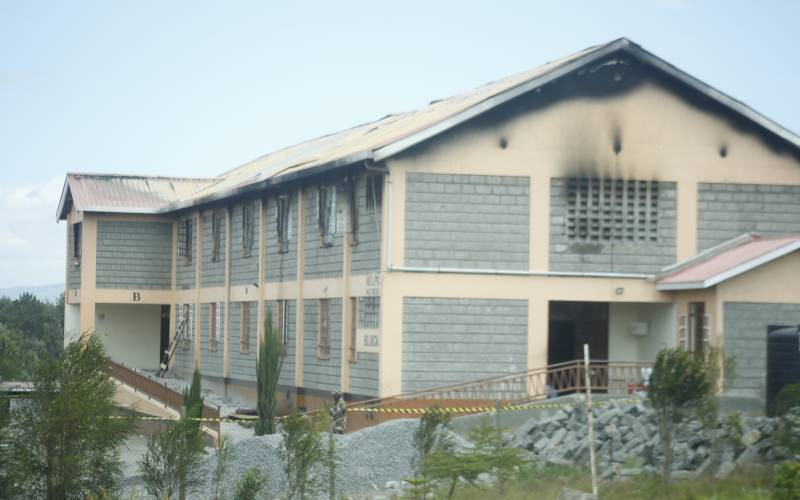
Burnt dormitory at Utumishi girls' high school in Gilgil, Naivasha. [Collins Oduor, Standard]
CCTV footage that investigators say links eight Utumishi Girls Academy students to a dormitory fire that killed 16 learners has sparked public anger and drawn renewed scrutiny of the country’s child justice system.
After the footage was shared on different social media platforms, comments were divided.
Some said the suspects should be charged as criminals, while others argued that cases of children in conflict with the law are handled differently.
According to the Children’s Act 26 (1), a child shall not be deprived of his or her liberty or otherwise treated in a manner contrary to Articles 29 (f) and 51 of the Constitution, except in accordance with the Persons Deprived of Liberty Act (Cap. 90A).
Children deprived of liberty, detained or held in custody or committed to an institution, shall be held separate from adults in facilities, including transportation facilities, appropriate to their special needs and age.
Advocate Morris Kimuli says once a crime has been committed, the police have a duty to investigate and arrest anyone who is responsible. Where it appears the people who are responsible are minors, the setting will change from the time the child is interrogated.
“Authorities are now trained to understand that in everything that you do, you must remember it is in the best interest of the child, regardless of what the child has done, and regardless of the circumstances under which you come into contact with the child,” Kimuli says.
Once it is determined that a child has committed an offence, the matter must then be referred to the Director of Public Prosecutions, who decides on the kind of offence to be charged.
Criminally liable
Kimuli adds that anybody who is below the age of 12 years cannot be criminally liable, meaning you cannot even prefer charges against that person.
“But if you are above 12 years, then you can be criminally liable. And if you are taken to court, you are entitled to a lawyer regardless of the nature of the offence that you have committed,” says Kimuli.
He says children are treated differently, even during the trial. They are not even addressed as accused persons. They are subjects. They can’t be convicts; they can only be found guilty.
“Even after you find them guilty, you are also restricted in what you can do. The Children’s Act and the policy of the Judiciary say that detention is the last resort.
“Pre-trial detention is where you are supposed to release this person pending the trial.”
Kimuli says children are also entitled to be with their guardians, or committed to institutions that can take care of them if they don’t have responsible guardians during the trial.
They are also supposed to continue being in school because they have not been found guilty.
When found guilty of murder or manslaughter, they will be sent to a borstal institution.
A borstal institution is a specialised youth detention and rehabilitation centre primarily catering to young offenders between the ages of 15 and 18.
Unlike adult prisons, these facilities focus on holistic reformation.
Kenya has three borstal institutions: Kamae Girls Borstal (Nairobi), located at Kamiti Maximum Prisons, Shimo La Tewa Borstal Institution (Shanzu, Mombasa) and Shikusa Borstal Institution (Kakamega).
“Once the child goes to the Borstal institution and if they behave well, a probation report will be prepared and given to the authorities and it will be determined that they can be released before the lapse of the three years,” Kimuli says.
They can stay in the institutions for up to 3 years. After they will be released, the presumption being that they have been sufficiently corrected. They will not be taken to adult prisons.
“Traditionally we used to do that,(take them to adult prison) but now the international convention on the rights of the child and our children's act does not suggest that you can do that,”
Kimuli adds that traditionally jailing was considered to those who turned 18 at the time of sentencing, like adults. But the general consideration now is that if the offense was committed when this person was a child, then they will apply the standards of a child in handling them.
“The courts are divided on this question, but the Children's Act is clear that if culpability is attached to a person when they were a child, they need to be treated as children,” he says.
Mob Psychology
Sociologist Alex Munyere says peer pressure and mob psychology play a huge role in such incidences.
Mob psychology is the phenomenon where individuals adopt the behaviours, emotions, and beliefs of a larger group. It is characterized by a loss of individual identity and critical thinking, causing people to act in ways they normally wouldn't on their own.
“When in a group when they say let’s burn the dorms you would. But when you are alone you will probably not be able to do it. When people are together in a mob, they tend to do weird things. Otherwise, you would not do anything of that nature when you are alone."
Munyere says students should be provided with avenues to vent. “Maybe one of the students would have said, I will not participate, or dissuade the others.”
Office of the Director of Public Prosecution
A Prosecutors Guide to Children in Criminal Justice posted by the Office of the Director of Public Prosecution states that a child is entitled to representation as is guaranteed by the Laws of Kenya and it is the duty of all prosecutors to respect and uphold this right at all times when the child is being processed within the criminal justice system.
This is a legal guarantee and safeguard that ensures that no injustice is occasioned on the child throughout the process. This is important because a child does not have the capacity to understand legal procedure and is, therefore, unable to represent himself or herself.
Thus, it is the responsibility of all duty bearers to ensure that all children within the criminal justice system are represented.
The guide further stated that any child within the criminal justice system, either as a child in conflict with the law or a child in contact with the law (as a victim or witness), must be protected from torture or other cruel, inhumane, degrading treatment or punishment.
Further, they should not be unlawfully or arbitrarily deprived of their liberty.
Subscribe to our newsletter and stay updated on the latest developments and special offers!