×

The Standard e-Paper
Home To Bold Columnists





Audio By Vocalize
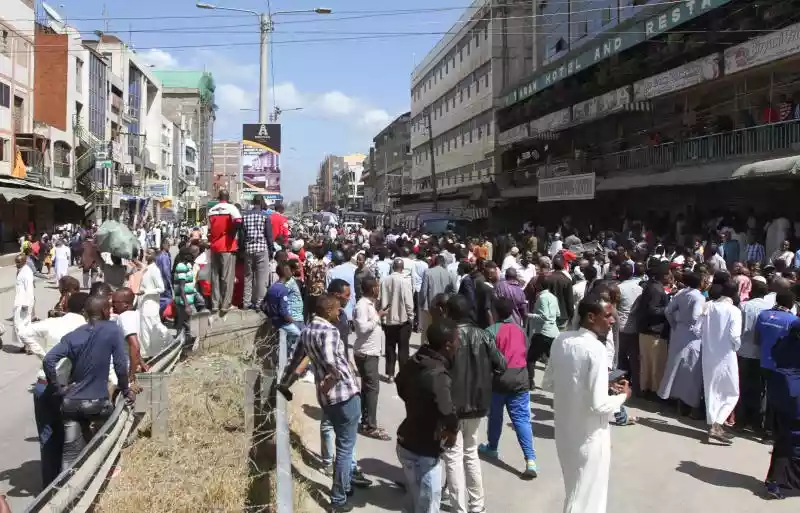
Eastleigh, one of the capital city’s busiest commercial and multicultural neighbourhoods, has found itself at the centre of national conversation after local leaders outlawed public gatherings organised around Somali clan flags.
In taking the action, the leaders argue that such displays threaten community cohesion, undermine Kenya’s sovereignty and risk importing political divisions that have long destabilised neighbouring Somalia.
The decision was reached during a meeting bringing together Kamukunji MP Yusuf Hassan, Eastleigh business leaders, community elders, religious leaders, administrators and security agencies.
The leaders resolved that public display of Somali clan emblems, banners and flags during street celebrations would no longer be permitted. Security agencies have been directed to enforce the ban by taking action against individuals organising or participating in clan-centred public processions, particularly the annual celebrations commonly witnessed around August.
This move has sparked debate, with supporters describing it as a necessary safeguard for national unity while others cautioning that authorities should distinguish between legitimate cultural expression and activities that threaten public order.
But area lawmaker Hassan is uncompromising on the resolution. He says Eastleigh’s identity must remain firmly rooted in Kenya’s national fabric.
“Clan politics destroyed Somalia, and we cannot allow that toxic politics to find space in Kenya. Eastleigh belongs to all Kenyans, and we must preserve peace, unity and the rule of law,” he says.
Commercial hub
The MP reminded residents that Kenya recognises only one national symbol. “We only have one flag in this country, and that is the Kenyan flag.”
For decades, Eastleigh has transformed from a modest residential estate into one of East Africa’s most vibrant commercial hubs.
Its bustling shopping malls, wholesale warehouses, hotels, transport companies, logistics firms, financial institutions and real estate investments generate billions of shillings annually while employing thousands of Kenyans from diverse ethnic, religious and national backgrounds.
Home to one of the largest Somali communities outside Somalia, Eastleigh has become an important gateway connecting Kenya to markets across the Horn of Africa, the Middle East and Asia.
Business people from Somalia, Ethiopia, Djibouti, Uganda, Tanzania and beyond converge daily in Eastleigh to trade textiles, electronics, household goods, construction materials, food products and consumer merchandise.
Leaders say preserving stability within such an economically strategic district is essential not only for Nairobi, but for Kenya’s broader economy.
The ban follows years of increasing public celebrations organised around Somali clan identities.
During these events, participants often seen carrying clan flags, displaying banners bearing clan emblems, driving through Eastleigh in motorcades, singing clan songs and holding street processions celebrating the achievements or unity of specific clans. The gatherings frequently accompany weddings, cultural festivals, fundraising drives, reconciliation meetings, youth events, visits by prominent elders, business milestones and commemorations linked to Somalia’s political calendar or clan history.
Organisers generally describe the celebrations as cultural events intended to strengthen social bonds among relatives and community members.
However, critics argue that once clan identity becomes the centrepiece of public mobilisation, such activities risk creating unnecessary divisions and reviving rivalries that Kenya has worked hard to keep outside its borders.
“This is a step in the right direction. We only have one flag in this country and that’s our unifying symbol. Clan stratification has often created major tensions in Eastleigh,” one community leader said.
The debate has also revived discussions about Somalia’s long-standing clan system. For centuries, clans have served as the foundation of the Somali society. They have traditionally provided identity, mutual support, conflict resolution, marriage networks, inheritance structures and social protection long before the emergence of modern nation states.
Clan affiliation remains deeply embedded in Somali culture and family life. By itself, clan identity is neither unlawful nor inherently divisive. The challenge, however, arises when clan identity becomes politicised.
Following the collapse of Somalia’s government in 1991, armed groups aligned with different clans competed for political power, territorial control and resources.
Although Somalia’s prolonged instability has resulted from a complex combination of governance failures, terrorism, foreign interventions, poverty and weak institutions, analysts generally agree that politicised clan rivalry significantly intensified the conflict and complicated efforts to rebuild national governance.
Many Somali elders, scholars and civil society leaders now advocate placing national identity ahead of narrow clan loyalties as Somalia continues its long journey toward lasting stability.
It is this historical experience that Kenyan authorities say informs their caution.
Security officials insist their concern is not directed at Somali culture but at preventing foreign political rivalries from taking root in Kenya where Eastleigh occupies a unique strategic position.
Its commercial success depends heavily on stability, investor confidence and peaceful coexistence.
Authorities argue that public mobilisation centred on clan identity could unintentionally trigger tensions between rival groups, increase political mobilisation linked to foreign conflicts and divert security resources toward avoidable confrontations.
The government has maintained that instability in neighbouring Somalia should never be allowed to spill across Kenya’s borders.
Two years ago, Mohamed Adow, an Assistant County Commissioner raised similar concerns.
“Our flag and our National Anthem should be respected. Hosting Somali clan flags in Eastleigh erodes the sovereignty of this country. Allowing it to thrive is like failing to recognise the authority of the President and the institutions of Kenya,” the administrator warned.
Multicultural society
Kenya’s Constitution guarantees freedoms of association, peaceful assembly and expression. However, Article 24 permits reasonable limitations on those rights where necessary to protect public safety, national security, public order or the rights of others.
Supporters of the ban argue that the measures target public mobilisation around divisive political identities rather than ordinary cultural expression. Community leaders have emphasised that the new measures are not intended to suppress Somali culture.
Somali language, poetry, literature, cuisine, traditional dress, music, weddings, religious celebrations and cultural festivals continue to enrich Kenya’s multicultural society.
The concern, they say, arises only when public events become centred on competition between clans rather than shared cultural heritage.
Maintaining that distinction, leaders argue, allows communities to preserve their traditions while safeguarding national cohesion.
Supporters argue that preserving Kenya’s sovereignty requires preventing imported political rivalries from taking root in public spaces.
They believe the country’s national identity must always supersede foreign political affiliations.
Others argue that authorities should carefully distinguish between peaceful cultural celebrations and activities that threaten security.
Most agree that Eastleigh’s remarkable economic success has been built on entrepreneurship, coexistence and stability rather than political divisions.
Maintaining that environment will require continued dialogue between security agencies, business leaders, religious institutions and residents.
Rise of flag clan celebrations
For decades, the light blue Somali national flag with its solitary white five-pointed star has stood as a powerful symbol of Somali nationalism, independence and unity.
Adopted six years before Somalia attained independence, the flag was intended to unite a people divided by colonial boundaries and inspire a common national identity.
The Somali national flag was designed by Somali scholar Mohamed Awale Liban and officially adopted on October 12, 1954, during the United Nations Trust Territory of Somaliland.
It was first raised in Mogadishu in 1954 before becoming the official flag of the Republic of Somalia on July 1, 1960, when British Somaliland and Italian Somaliland united to form an independent nation.
Its sky-blue background was chosen in recognition of the United Nations, which supervised Somalia during the trusteeship period between 1950 and independence in 1960.
At its centre sits the white star of unity, whose five points originally represented the five territories historically inhabited by Somali people - British Somaliland (present-day Somaliland), Italian Somaliland (modern Somalia), French Somaliland (now Djibouti) and the Somali Region of Ethiopia and Kenya’s North Eastern region.
The star symbolised the dream of bringing together all Somali people under one nation.
Speaking during previous Somali Flag Day celebrations, former Somali Prime Minister Abdi Farah Shirdon described the flag as a reminder of the country’s struggle for self-rule.
“Today I call on Somalis to come together in the spirit of national unity and brotherhood, leaving behind tribal divisions and rallying behind our great country. The flag represents the story of a national struggle against colonial power and the story of a proud people marching towards independence,” he said.
Today, however, a different trend has emerged alongside the national symbol. Across parts of Somalia and among sections of the Somali diaspora, public celebrations centred on individual clan flags, have become increasingly common, raising concerns among leaders that clan identity is beginning to overshadow national identity.
In 2022, confusion emerged after two Somali clans adopted nearly identical flag colours and organised celebrations on consecutive days.
The incident highlighted how clan flags have increasingly become symbols of competition rather than merely cultural identity.
Critics are calling for a distinction between celebrating Somali culture and promoting clan-based political identity.
Following the collapse of Somalia’s central government in 1991, armed factions aligned along clan lines became one of several factors that prolonged decades of civil conflict.
Although Somalia’s instability has also been shaped by terrorism, governance failures, economic hardship and foreign intervention, many scholars agree that politicised clan competition has significantly deepened divisions with Eastleigh fast becoming a perfect example.
Subscribe to our newsletter and stay updated on the latest developments and special offers!