×

The Standard e-Paper
Kenya's Bold Newspaper





Audio By Vocalize

He had barely learned how to hold a gun when he was thrust into one of the most dangerous assignments on the Russia-Ukraine battlefield — hunting deadly Ukrainian drones.
When Dickson Chege arrived in Russia in December 2025, he says he had no military experience, no weapons training and no idea he would soon find himself on the frontlines of the war in eastern Ukraine.
Within days, he says, he was deployed to the contested Donetsk region and assigned to a “drone hunting” unit tasked with detecting and countering Ukrainian drones that filled the skies
“We were two, and we did not go through any training. We were given guns a day after arriving at the camp, the next day and everything else,” Dickson Chege told The Standard in an interview.
Chege is among dozens of Kenyan returnees rescued with assistance from Kenya’s embassy in Moscow after being recruited into Russia’s war effort.
Prime Cabinet Secretary Musalia Mudavadi told Parliament on Thursday that the government had documented 291 reported cases of Kenyans enlisted into the Russian military, though The Standard established the number could be much higher.
Mudavadi said that Russia’s war against Ukraine has turned into a high-risk venture for job-seeking Kenyans. “The Russia-Ukraine war has attracted many Kenyans who have enlisted with the Russian military, more particularly the ex-service personnel,” he said.
But Chege was not a former soldier. He was an unemployed Kenyan youth searching for opportunities abroad before he found himself thrown into one of the world’s most technologically advanced wars.
“We were given guns, and the next day we were sent to the war without any training. Some who had been sent had undergone training for at least two weeks,” Chege said.
Another returnee, Javan Okoth, said he received only five days of military training at the Rostov Military camp before being deployed through Belgorod into Ukraine’s Kharkiv region. But according to him, guns were no match for the threat hanging above them; Ukraine’s menacing drones.
“When you serve on the frontlines of Russia’s army, the most dangerous thing that you deal with from the Ukrainian side are the many drones,” he told The Standard. “Drones killed many of our colleagues.”
They had left the military camp the previous day, and it took them an entire day to get to Belgorod and later into the frontline in Ukrainian territories held by Russia. There were five new recruits from Kenya in May last year.
“After we were given guns and told that we were now going to the frontline, one of our colleagues had a mental breakdown and started running all over the dangerous place. We tried to grab and hold him, but he broke free and ran off into open space and was struck by a drone. His body turned into parts flying all over the place.”
Okoth says the horror continued as they crossed rivers in combat zones.
“While carrying a dead body to protect myself from Ukrainian drones, we were struck. The body I was carrying broke into pieces, and I was injured in my right hand. Since my return to the country in September last year, I have been treating it and it's now healing,” he said.
Okoth said that on that first day, two of his colleagues were killed by drones as they crossed a river.
“After that, we moved to the second river, where almost everyone died except me and a friend who lost his right leg and left arm. The man is still in a Russian hospital today.”
Inside the ‘drone war’
For a Kenyan youth with no military or police experience, Chege faced a tall order serving in the drone hunting unit; a new method of warfare, as it is continuously being seen in Vladimir Putin’s conflict with Ukraine’s Volodymyr Zelensky.
According to Chege, drone detectors would alert troops to incoming attacks even before the machines could be heard.
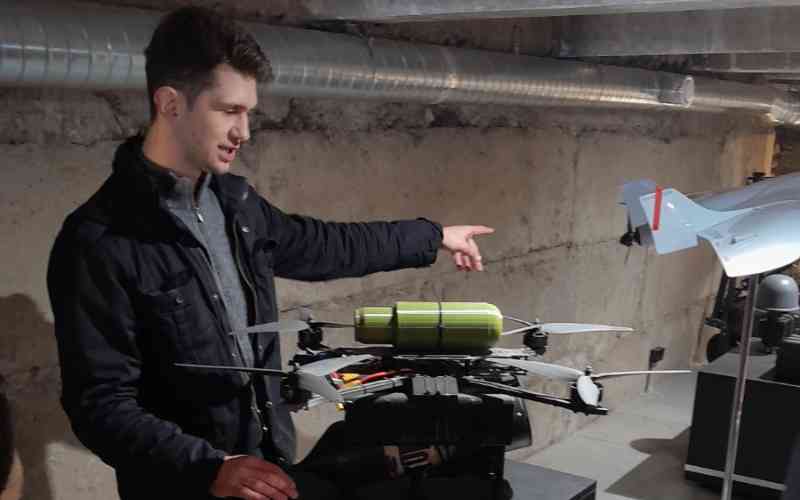
“We encountered a drone called Maverick once during an operation near a hospital, but FPV (First Person View) is the drone type that we encountered most,” he said. “The most feared drone from Ukraine is Baba Yaga.”
Baba Yaga is a nickname used by Russian forces for large, heavy-lift Ukrainian hexacopter and octocopter drones known for devastating nighttime bombing raids, high payload capacities and operating autonomously over long ranges. They are a major tactical threat to armoured vehicles and logistics.
“One time, we were working near a dam, and I saw many drones. We were attacked by 30 of them. There were so many types of drones, some of whose names I couldn't remember well. Some looked like aeroplanes and would fall silently, while others looked like missiles,” Chege said. “Most of the people dying on the frontline are being killed by Ukrainian drones. Meeting a soldier to exchange fire was quite rare.”
Ukraine’s drone revolution
Military analysts now believe that the world has walked into a new era of warfare where technological agility carries the day for any fighting sides.
“Ukraine's emergence as a drone superpower has made it extremely difficult for Russia to advance on the battlefield. Ukrainian drones now dominate the skies about the front lines, creating a kill zone 10 or 20 kilometres deep, and sometimes deeper,” said Peter Dickinson, Editor at the Atlantic Council, an American think tank on international affairs. “This makes it very difficult for Russia to concentrate troops and armour to launch offensives or achieve breakthroughs. Meanwhile, up to 90% of all Russian casualties are now inflicted by Ukrainian drones. This is a drone war in a very real sense”.
“We are currently in the midst of the biggest change in military warfare since World War I, which saw the advent of air forces, tanks, industrial killing, and chemical weapons,” says Dickinson. “Today, we are seeing unmanned systems at sea, on land, and in the air completely transforming the way wars are fought.”
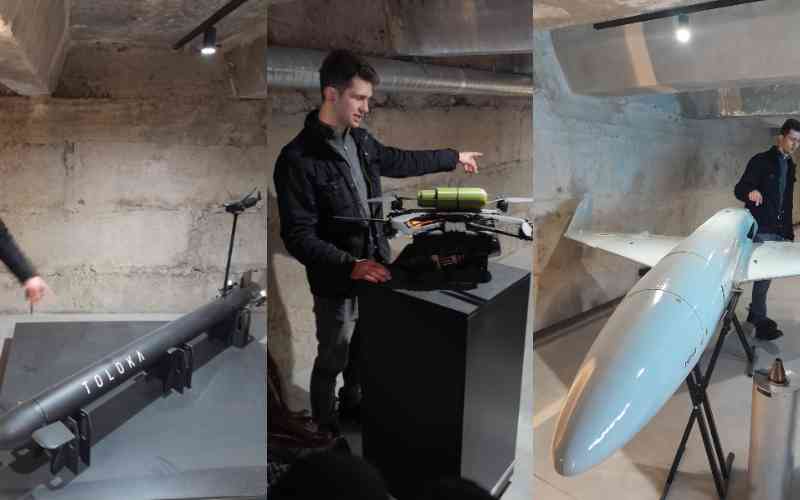
Today, we are seeing unmanned systems at sea, on land, and in the air, completely transforming the way wars are fought. He writes in his response to questions by The Standard that, over the past four years, drone warfare has advanced dramatically thanks to the intensive innovation cycles of the rival Russian and Ukrainian armies, which are locked in a competition to outsmart each other with new technologies daily.
As Russia’s Defence Ministry declared a unilateral ceasefire in Ukraine for Friday, 8th and Saturday 9th to mark the 81st anniversary of the defeat of Nazi Germany in World War II, it was cautious enough to throw out a threat of striking back at Kyiv if it tries to disrupt the Victory Day festivities.
Russia is consistently getting jittery of Ukrainian expanding drone technology. President Zelensky of Ukraine, in March, signed deals to share his technology with Gulf states: Qatar, Saudi Arabia, and the United Arab Emirates. That was followed by deals with Germany, and only last week, speaking in Yerevan, Armenia, Zelensky spoke about a deal with Finland of exchanging drone knowledge and skills.
The Guardian reported that as Russia was preparing to hold its annual Victory Day parade on Saturday, May 9, 2026, it was doing so without military hardware for the first time in almost two decades because of fears of a long-range attack by Ukrainian drones.
The defence ministry said no armoured vehicles or missile systems would roll across Red Square during the parade, which marks the Soviet victory over Nazi Germany, citing “the current operational situation”. Cadets from military schools and youth military institutions would also not take part, it added, reported the Guardian.
Ukraine’s ambassador to Kenya, Yurii Tokar, said the war has demonstrated how technology can offset military disadvantages.
“Today, Ukraine destroys Russian military systems worth millions – and sometimes billions – with the drone technologies that cost only a fraction of that amount. This is changing the very logic of modern warfare”
Senior International Relations Manager at Ukrainian Council of Defence Industries, Miroslav Popovich, said drones are the new chapter in warfare, the revolution on the battlefield. The battlefield is saturated with them, and the tactics of fighting have drastically changed. The most lethal weapon that Ukraine has today is a kamikaze FPV type.
“These drones are responsible for 70% of all the targets we destroyed or killed in 2024-2025 alone. But on the other hand, ISR drones (intelligence) are playing a crucial part as well, giving us live information on the enemy presence and movements,” said Popovich.
Russians, Dickinson argues, vastly underestimated Ukraine’s willingness and capacity to fight when they launched their full-scale invasion on February 24, 2022. Instead of a quick victory, Moscow encountered fierce resistance from a highly motivated Ukrainian force backed by strong Western support — initially led by the United States and, more recently, European allies.
According to Dickinson, another decisive factor has been Ukraine’s innovative use of drone technology. Ukraine quickly realised that drone warfare played to its strengths. Before the war, the country already had a strong IT sector and a vibrant start-up culture, conditions that allowed it to rapidly scale up domestic drone production once the invasion began.
What started in 2022 with only a handful of manufacturers has since grown into a vast defence-tech industry with hundreds of drone producers capable of manufacturing more than four million drones annually.
The rapid growth has enabled Ukraine to offset Russia’s overwhelming advantages in manpower, conventional weaponry and economic size, with Russia’s economy estimated to be more than ten times larger than Ukraine’s.
Subscribe to our newsletter and stay updated on the latest developments and special offers!