×

The Standard e-Paper
Kenya's Bold Newspaper





Audio By Vocalize

Now that he is a pensioner, Charles Mutoka should not be bothered with details of an ongoing foreign war happening in a world that is between 6000- 9000 kms away. The language spoken in the war alone runs in sounds whose alphabet is so disparate from his own that common sense guides him not to waste his time thinking about it. At 72, he is now an elder who was born and bred in the Global South, worked here and retired. He should not be concerned about decisions taken in Moscow and Kyiv.
But last year, after information reached him that his son had been killed while fighting in Ukraine for Russia’s army, he asked himself a question that remains big today: Can a man walk to his neighbour’s home, cause a war and then rather than use his own resources to wage that war, begins to run to his neighbours and deceive their sons to come help him complete his own war?
In March, the Department of Diaspora Affairs contacted Mutoka. He received their call while in his home in Siginga village, Port Victoria -Busia. He was called to come to the department’s offices in Upper Hill. When he got there, officials told him that his son Oscar Khagola had found his way to Russia, enlisted in the army at the Rostov Military barracks. While there, he was sent to the warfront and was killed in battle.
It now appears that even as Khagola’s wife, Milka Wangila, contacted The Standard in December last year and gave this paper the story of her tribulations in search for a missing husband, Khagola had already been killed in a war that is not of his motherland.
“When my son was killed, did he die protecting the soil in which he was born? Was it his motherland or fatherland?” Mutoka posed.
“That is a question I have been asking all foreign journalists who have interviewed me. What is Russia’s purpose of deceiving our sons into a war that is not theirs?” He asks.
In Nairobi, on March 23, 2026, officials at the Department of Diaspora Affairs asked him to forward his son’s list of next of kin to the office for compensation considerations. The promise was that it would be organised by the Russian Embassy in Nairobi and not the Kenyan government.
“I gave them the list of names of my grandchildren; my son’s five children, beginning with the eldest, who is now in Grade 10 at a national school. That was on March 23rd. I was to receive another communication from the government towards the end of April. They told me that they are not able to repatriate the body of my son for burial. That is why I decided to organise a mock burial for my son here. We buried a stone tablet on May 9.
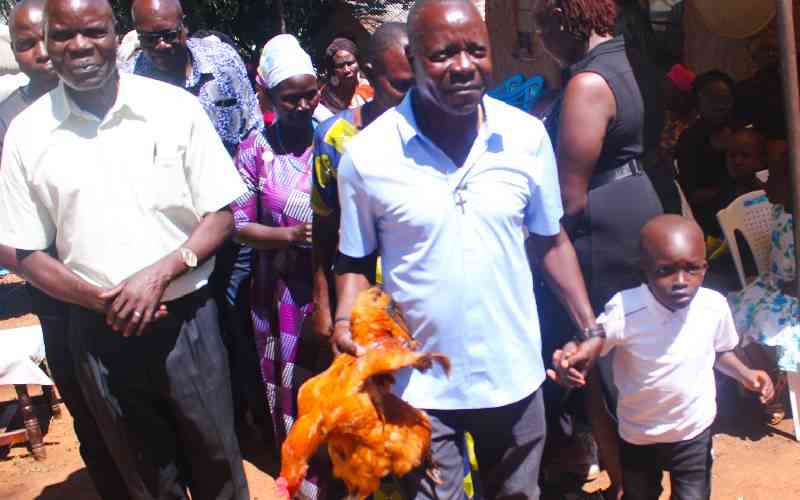
Charles Mutoka father of the late Oscar Khagola Mutoka during the ceremony in Mukhunga, Busia County, on May 9, 2026.. [Rodgers Otiso, Standard]
For Grace Gathoni, who lost her husband to the war, the information she got from the Foreign Office was a complete contrast to Mutoka’s experience. The last time Gathoni interacted with the department was in April. She was told that her husband’s name was not on the list that was in their possession. Because of that, there will be no compensation for her.
“Some families that have lost sons in Russia told me about being asked to present a list of next of kin for compensation”. Gathoni tells The Standard, “But when I went, that is what they told me.”
Gathoni had made numerous trips to the Department soon after The Standard broke the story of the death of her husband. Martin Mburu Macharia was the first Kenyan, Ukrainian authorities reported and shared pictures of his body, a copy of his passport and a Russian military Identity card on November 30 last year.
Macharia had been killed in the Donesk frontline described by the Ukrainian Army as a ‘kill zone’. Soon after receiving that information, she made several visits to the Department of Diaspora Affairs, each time finding a different official at the front desk and receiving a different explanation. In January, after one month of visiting and asking questions, her lawyer, Christopher Wainaina of Chacha and Company advocates, filed a petition to the Embassy of Russia and copied the Ministry of Foreign Affairs.
Towards the end of January, they received a letter dated January 24, 2026, from the Russian Embassy in Nairobi. The letter was a two-paragraph formal document referenced as No 80. Signed by a Mr Alexey Zamilatskiy, Head of the Consular Section.
The letter read: “The Embassy of the Russian Federation in the Republic of Kenya hereby communicates that the citizen of Kenya, Mburu Martin Macharia, born 28/8/1987, signed the contract for serving in the armed forces of the Russian Federation on 25/10/2025. On 01/12/2025, he was declared missing in action.”
The letter continued, “In view of the above, the Embassy kindly requests Chacha and Company Advocates, as a legal representative of the family of Mr Mburu, to transmit this information to his relatives”.
Three months later, perhaps hanging onto the Russian embassy’s word, the Department of Diaspora Affairs told Gathoni that the name of her husband was not on the list of Kenyans confirmed killed in Russia. That was despite Ukrainian authorities confirming the death of Macharia in what they described as ‘kill zone,’ an area of the frontline that no one can access.
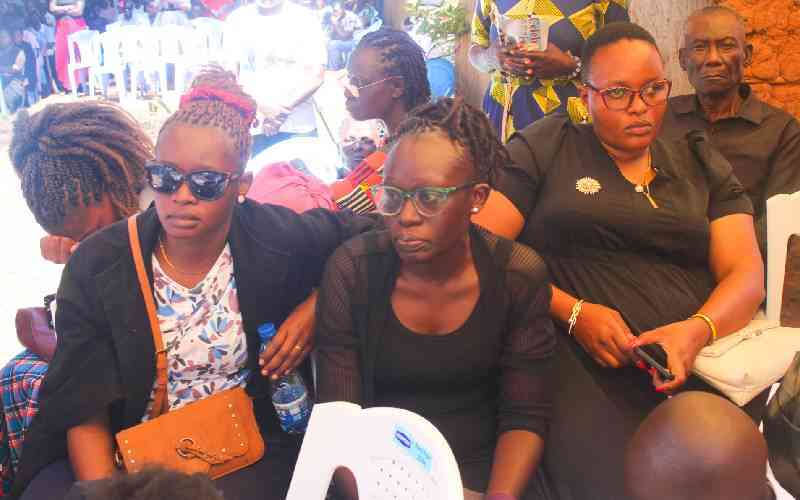
Responding on Friday to questions around compensation to families, Diaspora Affairs Principal Secretary Roseline Njogu said the government of Kenya does not compensate injuries resulting from illegal conduct.
"It is illegal as per our Penal Code for Kenyans to join military operations of other states without clearance and authorisation by the President," said PS Njogu.
The Diaspora Affairs PS said on the Russia side, any payment would be governed by the contract entered into by the worker or operative.
Peter Kamau, who has emerged as the voice speaking for families that have lost relatives to Russia’s war, says the department has been contacting families of individuals described by the Russian Embassy in Nairobi as Missing in Action.
“They have been giving the forms to fill mostly names of the missing individual and all next of kin”, Kamau said “ My brother, who went to Russia, has been missing since December 27, and I have not been contacted.
Kamau says the families seeking compensation are now more than 90.
Even as families push authorities for compensation, a narrative has emerged within government circles that all Kenyans who have found themselves serving on the frontline joined the Russian Army willingly. This is despite personal accounts of returnees who have shared copies of the signed contracts with The Standard
The contracts are written in Russian, which most Kenyans cannot read. Gathoni’s husband, Macharia, a former matatu driver, for instance, before he was sent to the frontline, had frantically reached his relatives back in Ruaka through WhatsApp communications and shared letters that he had sent to Kenya’s Embassy in Moscow.
Macharia also shared a copy of the contract he was duped into signing under duress, which is an incomprehensible document written in Russian, an alphabet not known to the majority of Kenyans.
The letter Macharia sent to the embassy cites his full name, Kenyan Passport number and declares that he was born on 28/08/1987. It reads: “I am writing to seek the urgent assistance and intervention of the Kenyan Embassy in Russia concerning my current situation. I travelled to Russia through a recruitment arrangement facilitated by the Military Personnel Agency, represented by Mr Alexander Loskutov. In Kenya, the agency’s representative was Mr. Nikolay Vitalievich Nicolat, who attached a copy of his passport.
Macharia said that according to the contract, he was to perform security services, cooking, or driving. However, upon arrival, he discovered that the actual assignment involved being issued a firearm and deployed to the warfront in Ukraine.
“I wish to emphasise that I have no military or police background, and I did not travel to Russia to participate in any armed conflict. I am extremely worried for my safety and well-being, as I find myself in a situation I neither consented to nor qualified for. I therefore humbly request the urgent intervention of the Kenyan Embassy in Moscow,” reads the letter shared in November last year
Kenya’s mission owned up to receiving numerous distress calls. In a letter shared with the Ministry of Foreign Affairs in Nairobi, a copy of which we have, which among them was Macharia’s, it is not clear whether he got help. What we have confirmed is that he was dispatched to the warfront where he was killed. According to Ukrainian authorities.
As the Kenyan government engages in an argument over the legal implications of their unemployed countrymen joining the Russian army and in-fact declare that it will not compensate for an illegality, two countries from the Global South whose citizens had fallen victim to Russia’s predatory recruitment have burned their midnight oil to save their people from Russia’s war.
In December last year, India’s Prime Minister Narendra Modi used the state visit by Russian President Vladimir Putin to push for the urgent release and evacuation of Indian nationals trapped in Russian military service, putting their safety and return home at the centre of the agenda.
Even as the two leaders discussed the wider Ukraine war and bilateral ties, Modi rubbed in the need for all Indians recruited through deception to be released and return home.
In a special briefing on the Russian President’s state visit to India, Foreign Secretary Vikram Misri underlined that New Delhi had raised the matter “strongly” and repeatedly with Moscow, with India seeking a verified halt to further recruitment of Indians into Russian forces and expedited repatriation of those already caught in the conflict.
Three months later, in mid-March, Kenya’s Prime Cabinet Secretary Musalia Mudavadi travelled to Moscow, and what he brought back home was what appeared to be a narrative developed by the Russian government that all Kenyans serving in the army had signed contracts and must serve their term.
A researcher on South Asian affairs and the Global South, Prof Pramod Jaiswal, told The Standard that Nepal and India have taken steps to contain Russia’s recruitment of job-seeking youths into the Russian military, although the problem has not been fully eliminated.
Dr Jaiswal, Research Director, Nepal Institute for International Cooperation and Engagement, said Nepal responded to Russia’s illegal recruitment by issuing diplomatic protests to Russia, requesting it to stop recruiting Nepali citizens. The government also halted labour permits for Russia and Ukraine, aiming to prevent Nepali youths from travelling there for work. In addition, Nepali authorities cracked down on recruitment agents and human-trafficking networks that were sending youths abroad with promises of lucrative jobs or student visas but eventually channelling them into military service. Similarly, India investigated trafficking rings that allegedly lured Indian nationals with fake employment offers and later forced them into frontline roles.
There have been discussions around compensation for victims, and that Russia agreed to compensate families of foreign nationals who died while serving in its military, including some Nepali recruits. Payments were reportedly to be processed through the Nepali embassy in Moscow and aligned with compensation schemes provided to Russian soldiers’ families.
“However, the implementation has been slow and inconsistent, and not all families have received compensation,” says Dr Jaiswal. “Civil society groups and affected families in both Nepal and India have continued to pressure authorities for transparency, repatriation of bodies, and full compensation”.
Subscribe to our newsletter and stay updated on the latest developments and special offers!