×

The Standard e-Paper
Home To Bold Columnists





Audio By Vocalize
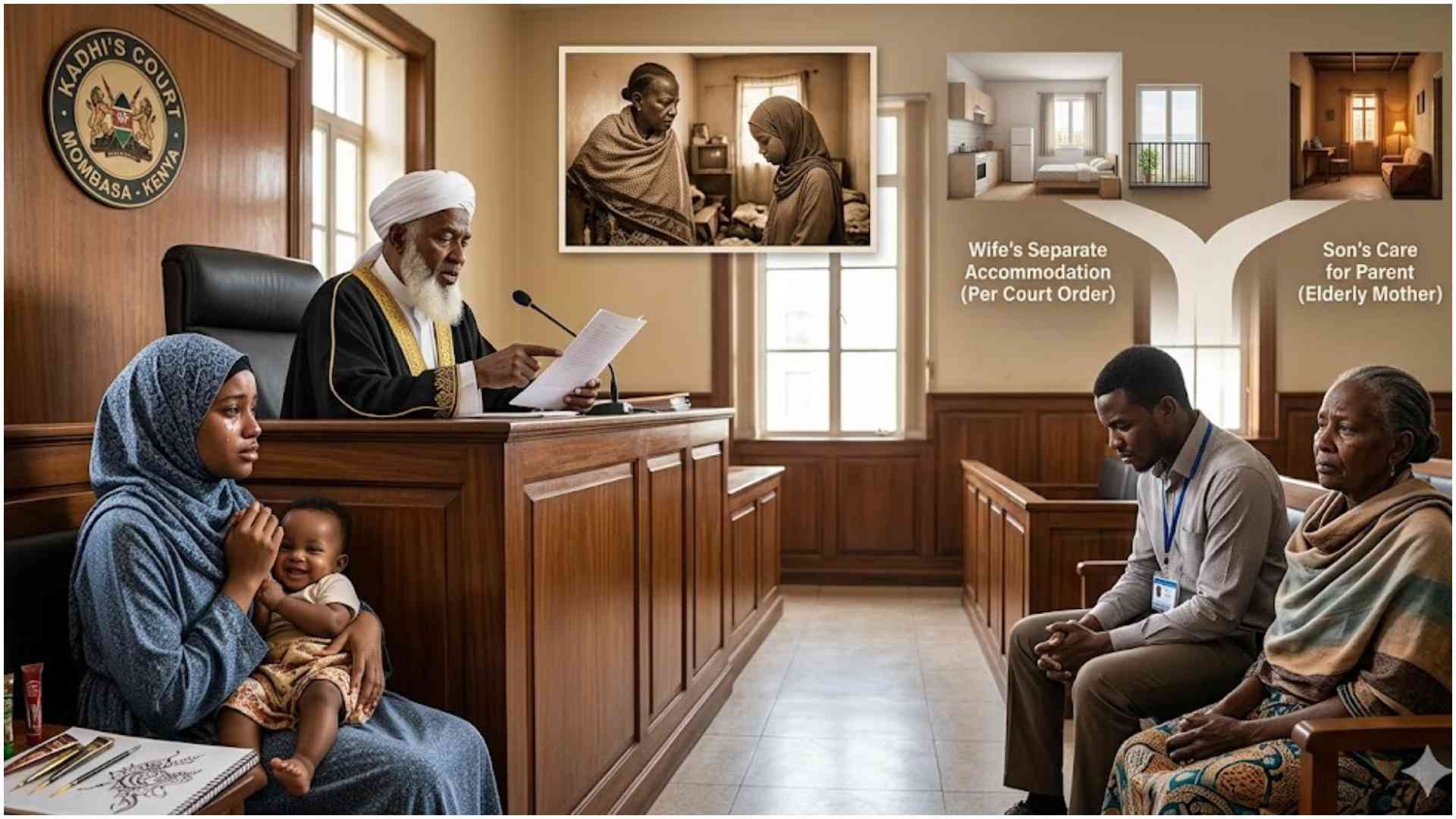
A family dispute over living arrangements has led the Chief Kadhi to issue a significant ruling clarifying that a Muslim man’s obligations to his wife do not override his duty to care for his parents, and vice versa, stating that where cohabitation between a wife and mother-in-law breaks down, Islamic law requires the husband to provide separate accommodation according to his means.
The decision arose from a case in Mombasa involving a married couple whose relationship deteriorated amid persistent tensions between the wife and her mother-in-law.
Stability
The Chief Kadhi ordered the husband to secure independent accommodation for his wife after she refused to continue living under the same roof as her elderly mother-in-law, citing unbearable conditions.
The woman, identified in court documents as AJN, told the Kadhi’s Court that repeated conflict in the matrimonial home had made it a source of distress rather than stability.
She alleged that her mother-in-law had contributed to ongoing friction, claiming she was mistreated and eventually forced to return to her parents’ home, leaving behind her breastfeeding infant.
AJN further accused her husband, identified as AMA, of arrogance, rudeness and harsh treatment, alleging that he consistently sided with his mother and failed to value her concerns.
Justice Hussein Athman ruled that AMA had a legal and religious obligation to provide separate accommodation for both his wife and his mother.
“The petitioner (AJN) has successfully demonstrated incompatibility with living alongside her mother-in-law. She has endured the situation for some time. Forcing her to continue living in such conditions would expose her to emotional and psychological harm and violate her marital right to independent accommodation,” Justice Athman said.
In her petition, AJN sought reconciliation as well as custody of their two-year-old son, stating she would consider returning to the marriage only if they lived in a separate rented home.
The court heard that AMA had initially rented a two-bedroom apartment in Ganjoni on Mombasa Island at Sh23,000 per month, where he lived with his wife, child and mother.
AJN said she was willing to live in a bedsitter costing Sh8,000 per month, but AMA argued he could only afford accommodation of Sh2,500 and was unwilling to relocate his mother.
Justice Athman ordered AMA to secure a one-bedroom self-contained apartment in Mombasa as the matrimonial home within 60 days.
“He is hereby ordered to secure a one-bedroom self-contained apartment within Mombasa as the matrimonial home within 60 days from the date of this judgment,” the judge said.
Arrangements
The court further directed AMA to pay Sh10,000 per month in child maintenance and ruled that, during the separation, custody of the child would remain with AJN, while AMA would have weekend visitation rights from 9am to 6pm.
It also ordered that the maintenance amount cover both the child and the mother until the new living arrangements are made.
AMA, however, told the court that his wife was aware prior to marriage that she would be living with his family, and argued that, as the family’s breadwinner, he had a responsibility to care for his elderly mother.
The couple, married under Islamic law in 2023 in Mombasa, have a two-year-old son. AJN is unemployed but runs a henna application business from home, while AMA works as a billing clerk at a local hospital.
In his judgment, Justice Athman noted that cohabitation with in-laws is generally an exception rather than the norm, adding that independent accommodation allows spouses to exercise their marital rights more fully and strengthens family stability.
He further observed that the right to accommodation is strongly protected in Islamic law, noting that a matrimonial home may, in certain circumstances such as the ‘iddah period, still be regarded as the wife’s residence.
The judge also highlighted the religious obligation to care for parents, citing Quranic injunctions on honouring and treating parents with kindness.
Accommodation
He emphasised that while shared living arrangements between spouses and in-laws may work where there is mutual agreement, they should not be imposed where serious conflict exists.
Where such arrangements fail, he ruled, the wife should not be compelled to live with her in-laws, though this does not automatically dissolve the marriage, as the husband remains responsible for providing separate accommodation within his means.
The court noted that while many families successfully manage multigenerational living, breakdowns in such arrangements can in some cases lead to marital strain and separation
In his judgment, Justice Athman noted that every wife, unless she consents otherwise, is entitled to separate accommodation and that living in a parent’s house is the exception rather than the norm.
The judge said independent accommodation allows spouses to fully explore their love and marital responsibilities and gives the marriage the greatest chance of success.
“The entitlement to accommodation is so strong that the matrimonial house is regarded as the wife’s house even during idda following a divorce, as provided for in Qur’an 65:1,” Justice Athman said.
However, he added that AMA, as a son, remains obligated to care for his parents, especially in their old age and if they are in need.
Subscribe to our newsletter and stay updated on the latest developments and special offers!