×

The Standard e-Paper
Join Thousands of Readers





Audio By Vocalize
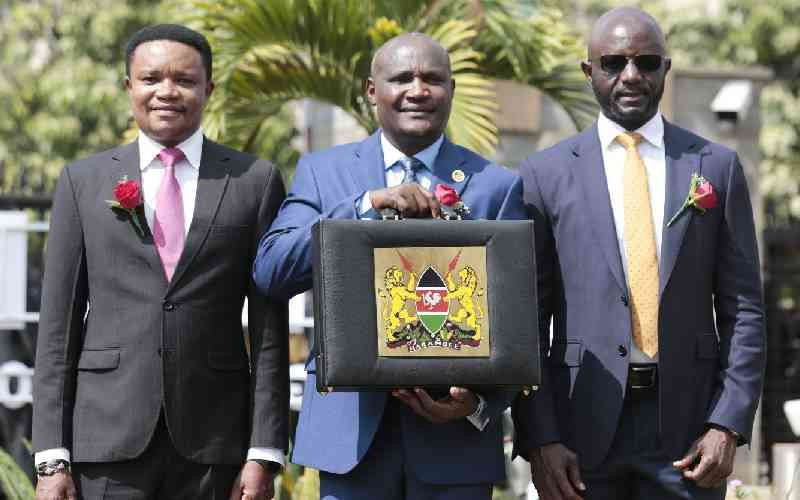
Treasury Cabinet Secretary John Mbadi called it a ‘‘Mwananchi Budget’’ — a budget for the common citizen. He promised no new taxes, affordable housing, and bottom-up transformation.
But economists, financial analysts, and new data on Kenya’s cost-of-living crisis say the 2026/27 spending plan delivers the opposite of a hustler economy.
“This budget ignores the less privileged citizens and favours the rich,” Samuel Nyandemo, an economics lecturer at the University of Nairobi, told The Saturday Standard.
“Remember the promise of exemption of those earning below Sh30,000 from paying tax was not honoured.”
Nyandemo’s critique cuts to the heart of President William Ruto’s 2022 campaign pledge to build a ‘hustler nation’.
With 14 months until the next election, the government’s spending plan relies on a domestic borrowing binge so massive that analysts say it will starve the very businesses and young people it claims to champion — while ordinary Kenyans face the sharpest slowdown in spending in nearly two years.
Previous borrowing
“The government finances are so constrained by previous borrowing and accumulation of debt, that it cannot spend on any meaningful investment to increase growth,” says Deepak Dave an economist and risk advisory expert.
“Without growth, there will be no incomes, and small subsidy attempts here and there are not improving things for the hustlers.”
Even before the budget was unveiled, Kenyan households were buckling under renewed price pressures.
Official data released on May 29 showed annual inflation jumped to 6.7 per cent in May, its highest level since early 2023, driven by a 16.5 per cent surge in transport costs and 9.4 per cent rise in food prices.
“The price increase was primarily driven by a rise in prices of items in the Food and Non-Alcoholic Beverages; Transport; and Housing, Water, Electricity, Gas and fuel basket,” Kenya National Bureau of Statistics Director General Macdonald Obudho said in the report
Those items account for more than 57 per cent of the Consumer Price Index.
Knock-on effects
Diesel prices in Nairobi soared 18.4 per cent between April and May alone, and were up 41.2 per cent from a year earlier.
Petrol rose 8.4 per cent month-on-month. Kerosene — a key fuel for low-income households— jumped 25.3 per cent in just one month.
The knock-on effects cascaded through the economy.
Bus fare from Voi to Thika leapt 25 per cent to Sh1,500. Tomatoes surged 45.7 percent year-on-year.
A 13-kilogramme gas cylinder now costs Sh3,471 – up 10.5 percent annually.
Analysts say the government promised to lower the cost of living, but inflation is now at 6.7 per cent and families are struggling to buy food.
A new survey by Standard Bank and S&P Global, published in late May, captured the human toll.
“Consumer resistance to spend, alongside rising costs, contributed to contractions in new orders and output,” said Christopher Legilisho, an economist at Standard Bank.
At a downtown market in Naivasha, The Saturday Standard found far more idle shop attendants than customers.
“People come, look at the price, and walk away,” said Mukami Wanjiku, who sells second-hand clothes. “They say ‘no money’ and leave.” The survey, which polled more than 400 companies, found that new sales decreased at the fastest pace since July 2025.
“Constrained budgets” and “customer hesitancy” were repeatedly cited as the main forces killing demand.
Businesses increased prices at the fastest pace in two and a half years — a brutal cycle where shoppers face higher charges just as their ability to pay dwindles.
For the first time in 16 months, firms have cut jobs. The axe fell mainly on temporary workers.
“Reduced pressure on capacity via a fall in new orders led firms to cut their workforce numbers,” Legilisho said.
Against this backdrop of household distress, the government unveiled a budget that borrows a record Sh1.03 trillion from local banks — nearly 90 per cent of all deficit financing
The government plans to spend Sh4.82 trillion in the financial year starting July 1, but will collect only Sh3.63 trillion in revenue.
The resulting deficit — Sh1.146 trillion, or 5.5 per cent of Gross Domestic Product — will be financed almost entirely from domestic lenders.
Just Sh116 billion will come from foreign donors, according to budget documents tabled in Parliament on Thursday.
“What the government proposes is economically unsound,” said a senior Treasury official who spoke on condition of anonymity.
“The State is competing directly with the private sector for a limited pool of funds. Banks will always choose risk-free Treasury bills over commercial loans.”
The most telling omission, several analysts noted, is the Hustler Fund – Ruto’s flagship bottom-up promise. Launched in 2022, it disbursed Sh87 billion to 28 million accounts. In the 2026/27 budget, it receives zero allocation.
Financial analyst
“From a Sh20 billion launch year, the fund has dwindled to nothing,” said a Nairobi-based financial analyst who asked not to be named.
“That leaves millions of informal borrowers without a State-backed safety net.
‘‘This is not bottom-up. This is abandonment.”
Mbadi proposed Sh550 million for the Centre for Entrepreneurship Project and Sh1.1 billion for the Rural Kenya Financial Inclusion Facility.
But independent analyst Ian Njoroge, says the allocation are “a drop in the ocean” compared to the credit crunch facing micro, small, and medium enterprise, which account for 98 per cent of all businesses and 14.9 million job “These are the very enterprises that employ hustlers,” Njoroge said.
“The budget gives them nothing while taking everything from the banks.”
For young jobseekers, the picture is equally bleak.
The government has no comprehensive youth employment strategy, according to a review of the budget documents.
The NYOTA programme receives Sh4.9 billion — a fraction of the Sh80 billion Youth Employment Compact proposed by the opposition.
Funding for Technical and Vocational Education and Training has been reduced by Sh3 billion, and the Public Service Internship Programme has been halved.
For contractors and suppliers who built roads, bridges, and schools on government credit, the budget offers only a partial solution.
Mbadi allocated only Sh68 billion in 2026/27 to settle pending bills, targeting only those owed up to Sh100 million.
County governments face even starker abandonment, analysts say.
Mbadi noted that counties have outstanding pending bills of Sh183 billion but offered no bailout, no debt relief, and no new transfers.
He merely “urged” county governments to implement action plans.
Subscribe to our newsletter and stay updated on the latest developments and special offers!