×

The Standard e-Paper
Truth Without Fear





Audio By Vocalize
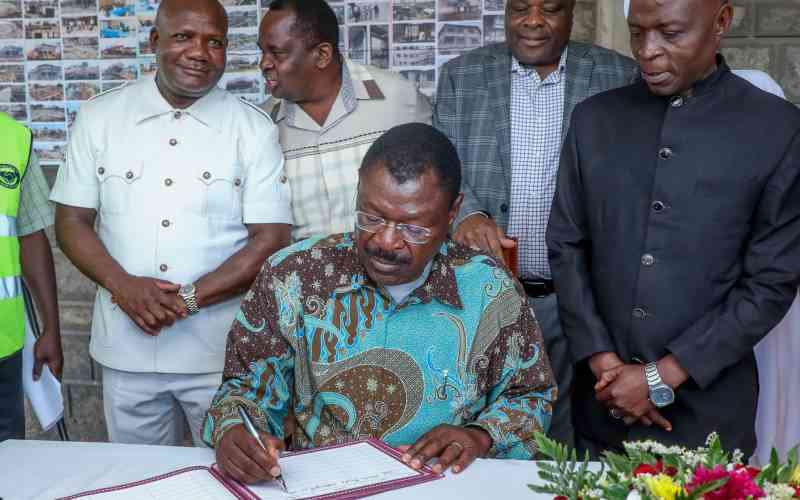
He goes by the political moniker Papa wa Roma and indeed he is probably living up to that billing and is that father, brother, cousin or uncle who does not promise you he will see what to do when you request him to assist you with a job search; he acts. In Bungoma, National Assembly Speaker Moses Wetangula has been enjoying support from his support base as he lobbied for projects and positions for the region. But one thing is strikingly clear-several members of his family are enjoying the trappings of power in plum government positions.
Their family is the definition of a powerful family. They are the who is who in the country’s leadership, enjoying plum positions and are integral in the country’s corridors of power, as their deep family ties permeate public service and the country’s political scene. From Cabinet Secretaries, former Cabinet Secretaries, to Principal Secretaries, Sitting and former Members of Parliament, and Presidential Advisors, the family is among the spines of governance in the country.
On Saturday, as the family convened in Chwele, Bungoma, to participate in the burial of one of the pillars that brought them together, several people, including mourners, were left dumbfounded at the success that the family is enjoying as close kin enjoy the trappings of power.
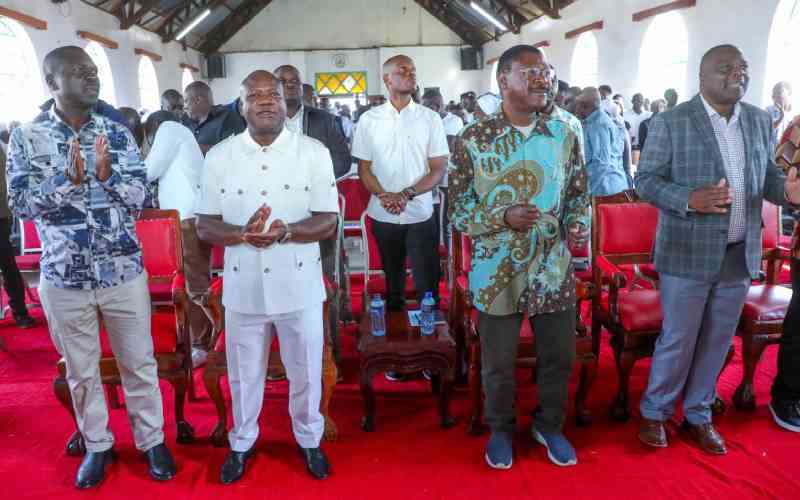
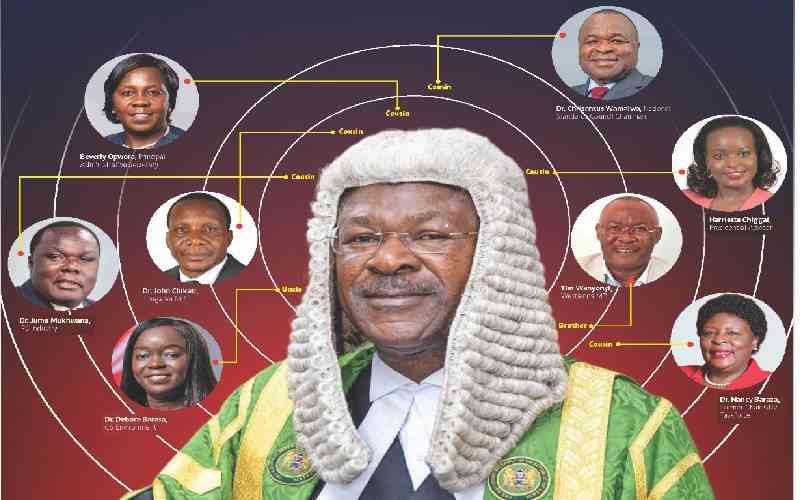
The burial of Mama Racheal Nakhumicha Kituyi unexpectedly thrust Wetang'ula and his extended family into the centre of a heated national debate over government appointments, regional equity, and the sharing of power. What was intended to be a solemn obituary announcing the passing of has instead evolved into one of the country's biggest political talking points after it listed dozens of relatives occupying influential positions in government, Parliament, and independent State institutions.
Published in a national newspaper, the obituary identifies the deceased as Speaker Wetang'ula's aunt and outlines an extensive network of close and extended family members serving in some of Kenya's highest public offices.
Among those listed are Environment Cabinet Secretary Deborah Barasa, Principal Secretary for Industry Dr Juma Mukhwana, Westlands MP Tim Wanyonyi, Presidential Advisor on Women's Rights Harriet Chiggai, and Principal Administrative Secretary in the Ministry of Interior Beverly Opwora.
Others are former Kiminini MP and Chairperson of the Kenya Bureau of Standards (KEBS) Board Chris Wamalwa, former Deputy Chief Justice Dr Nancy Baraza, and former Tongaren MP John Chikati, among several other relatives serving in influential public positions. Baraza serves as the chairperson of the Presidential Technical Working Group on Gender-Based Violence (GBV) and Femicide, a task force appointed by President William Ruto to recommend measures to address GBV and femicide.
The obituary further traces the family's lineage to the late Paulo Wanjala (Lugongo Omusaba) and Delila Nelima (Omusomi) of Namwela in Chwele, Bungoma County. Almost immediately after its publication, social media erupted with debate, with many Kenyans questioning whether one extended family had accumulated an outsized share of influential government appointments.
Users coined phrases such as "Broad-Based Family," while others sarcastically remarked, "Bila connections Kenya hii ni kazi bure," suggesting that family and political connections appeared to carry greater weight than merit in securing senior public offices. Although no evidence has been presented that any of the listed officials were appointed unlawfully or failed to meet constitutional requirements, the disclosures have reignited a long-running national conversation about perceived nepotism, regional balance, and equitable access to public opportunities.
Kenya's Constitution requires public appointments to reflect regional and ethnic diversity while promoting merit, a standard that frequently comes under scrutiny whenever politically connected families dominate senior offices.
The revelation has also revived political discontent that has been steadily building in Western Kenya, where opposition leaders argue that appointments intended to benefit the region have largely been concentrated around a small circle linked to its most senior political figures.
At the centre of those criticisms is Trans Nzoia Governor George Natembeya, who has repeatedly challenged Speaker Wetang'ula to explain what tangible benefits Western Kenya has realised from the pre-election agreement signed between Kenya Kwanza leaders and President Ruto ahead of the 2022 General Election.
Natembeya argues that although the region secured some of the country's most influential offices, ordinary residents have little to show in terms of employment, industrial revival, economic transformation, and infrastructure development.
"These are men who have been in government for most of their political lives, yet we cannot point to what they have brought to uplift the community," Natembeya has repeatedly said during political rallies, questioning Wetang'ula's legacy.
According to the governor, the agreement between Kenya Kwanza and Western leaders was never intended to benefit only a handful of politically connected individuals but to uplift the entire region through development projects, equitable distribution of government opportunities, and the revival of struggling industries.
The controversy has also drawn criticism from Bungoma gubernatorial aspirant Zachariah Baraza, who, while condoling with the bereaved family, questioned the concentration of appointments.
"As much as we condole with the family for the loss of their matriarch, it appears nearly 30 per cent of the Kenya Kwanza allocation for Western was taken by one family," Baraza remarked.
The debate traces earlier statements by former Deputy President Rigathi Gachagua, who accused Prime Cabinet Secretary Musalia Mudavadi and Speaker Wetang'ula of abandoning the region after securing influential government positions.
Gachagua argued that the memorandum negotiated before the 2022 elections promised Western Kenya much more than Cabinet and parastatal appointments.
According to him, the agreement envisioned the revival of struggling sugar factories, including Nzoia Sugar, payment of farmers' arrears, completion of stalled infrastructure projects, expansion of electricity connectivity through the Last Mile Programme, implementation of water projects, and construction of at least 1,000 kilometres of new tarmac roads.
"I was there when the memorandum allocating 30 per cent of government opportunities to Western Kenya was being negotiated. Later, it was changed and their relatives were included. Only two promises have been fulfilled—the positions held by Mudavadi and Wetang'ula, which mainly benefit them and their families," Gachagua alleged during a recent political tour.
He further accused the two leaders of negotiating jobs for their relatives while failing to secure sufficient employment opportunities, industries, and development projects for ordinary residents. "The people of Western Kenya have been used like tissue paper. They are remembered during elections and forgotten immediately afterwards," he said.
Nicknamed "Papa wa Roma", Wetang'ula has been vocal recently across the region in pushing for the re-election of President Ruto next year. Speaker Wetang'ula has, however, strongly rejected claims that Western Kenya has been sidelined or short-changed.
Speaking during the burial of Mama Racheal at Sichei-Nambaya Village in Chwele, Bungoma County, the Speaker described the deceased as much more than an aunt, acknowledging the close family relationship.
"I am mourning my friend and a mother. Her husband is my mother's first cousin, and we have always been very close. Mama Rachel was part of my political team. She was my political adviser, mentor, and someone who constantly guided me," he said.
Seemingly responding to allegations of nepotism, Wetang'ula defended President Ruto's administration, arguing that Western Kenya has received more senior government appointments than under previous administrations.
He cited his own election as Speaker of the National Assembly, Mudavadi's appointment as Prime Cabinet Secretary, the Cabinet appointments of Wycliffe Oparanya and Deborah Barasa, together with eight Principal Secretaries drawn from the region.
"As a region, we have received major government positions despite the numbers we delivered during the election. The only route to getting what we have always wanted is through the Kenya Kwanza government. President Ruto has demonstrated goodwill, friendship, and patriotism to every part of Kenya. We should ignore propaganda politics," Wetang'ula said.
The Ford-Kenya party leader also pointed to ongoing infrastructure projects as evidence that the government was delivering on its promises.
Among the flagship projects he highlighted were the Sh8 billion Sichei Level Six Hospital, funded by the African Development Bank; the rehabilitation of the Misikhu-Brigadier Road; the Musikoma-Sang'alo-Kakamega Road; affordable housing projects; modern markets, hospitals, and schools; and the expansion of national polytechnics.
Family members also defended the Speaker, terming him a development-driven leader. CS Mulongo paid tribute to her late grandmother, describing Mama Racheal as a woman whose wisdom, compassion, and selfless service had positively impacted generations of residents.
Former Health Cabinet Secretary Susan Nakhumicha dismissed claims that Wetang'ula had failed to uplift his community while also appearing to respond to speculation that the Speaker had influenced her own appointment.
"When someone says Wetang'ula has not assisted his people, that is not true. He has brought development, and many people have secured employment through his leadership. The Sichei hospital project began during my tenure and will greatly benefit residents by reducing referrals to Eldoret," she said.
Industry Principal Secretary Juma Mukhwana described the late Mama Rachel as a respected community pillar whose influence extended across generations. He urged residents to support President Ruto's re-election in 2027, arguing that continuity in leadership would guarantee completion of ongoing development projects. Kiminini MP Kakai Bisau echoed those sentiments, saying Western Kenya must remain politically united if it hopes to one day produce a president.
"We must work together and build a formidable team. Since Independence, no president has undertaken as much infrastructure development as William Ruto. Residents should register as voters and elect leaders who will unite the region," he said.
Political analyst Moses Ombayo believes the growing controversy reflects deeper frustrations that are likely to shape political alignments ahead of the 2027 General Election.
"The conversation has moved beyond appointments. Many residents are now asking whether the political bargains struck before the last election have translated into measurable economic benefits such as jobs, industries, and improved livelihoods," Ombayo said.
He added that while government appointments remain politically significant, voters are increasingly evaluating leaders based on the development they deliver.
"If the leadership fails to address the growing feeling of exclusion among sections of the region, Western Kenya could become one of the most fiercely contested battlegrounds in the next General Election." With more than 2.6 million registered voters across Western Kenya's five counties, the region remains one of the country's most strategic voting blocs.
Subscribe to our newsletter and stay updated on the latest developments and special offers!