×

The Standard e-Paper
Read Offline Anywhere





Audio By Vocalize
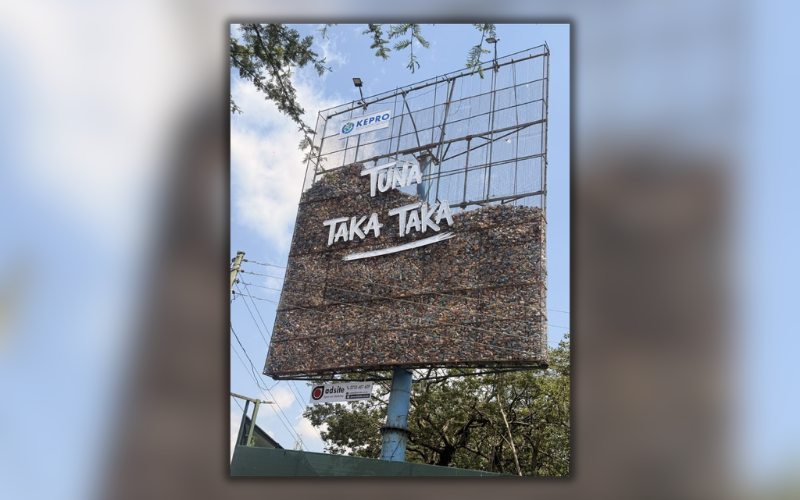
A billboard made entirely from plastic waste has become an unlikely attraction in Nairobi, drawing the attention of motorists, pedestrians and social media users, not for what it advertises, but for what it is made of.
Standing along University Way, the installation is part of the Tuna Taka Taka campaign, an environmental awareness initiative encouraging Kenyans to rethink how they dispose of plastic waste.
The billboard highlights the importance of recycling and responsible waste management.
The campaign's name, Tuna Taka Taka, is a play on Swahili words that take on different meanings depending on pronunciation and context.
It can be interpreted as "we want waste", "we have waste", or even refer to littering, a deliberate wordplay designed to spark conversations about how society handles waste.
Its location was carefully chosen, according to Said Suleiman, a Communications Officer at the Kenya Extended Producer Responsibility Organisation (KEPRO).
"We wanted to reach as many people as possible, and the location is strategic because it serves schools, businesses, corporate offices and people using the flyover," Suleiman told TNX Africa.
The scale of the problem the campaign targets is massive.
According to the National Environmental Management Authority (NEMA), Kenya generates an estimated 22,000 tonnes of total waste daily, and about 20 per cent of this is plastic.
Annually, the country produces roughly 966,000 tonnes of plastic waste, putting severe pressure on local ecosystems.
Plastic has become an essential part of daily life, with most consumer goods packaged in it.
However, poor disposal has led to plastic waste accumulating in rivers, along roadsides and in public spaces, creating one of the country's growing environmental challenges.
According to Suleiman, the campaign is not about eliminating plastic but promoting responsible management.
"We don't want people to throw plastic all over the place. We want people to segregate it because plastic can be recycled and turned into other useful products," he said.
Currently, only about 27 per cent of the plastic waste generated across the country is collected, and a mere 8 percent actually gets recycled.
The rest is either taken to landfills, incinerated, or simply ends up polluting the natural environment.
All the while, recycled plastic can be transformed into a wide range of products, including clothing, construction materials and household items.
Suleiman noted that plastic can remain in the environment for centuries if not properly managed.
"Plastic can take almost 450 years to decompose. That is why we are creating awareness so people understand the importance of collecting it instead of throwing it away," he said.
The campaign also encourages households and institutions to adopt the three-bin waste segregation system: blue for recyclable waste such as plastics, black for general waste and green for organic waste.
Separating waste at the source makes recycling more efficient and increases the amount of material that can be recovered and reused.
Adding to the campaign's message, the billboard itself contains approximately 2.9 tonnes of recycled plastic.
Once the awareness drive ends, the material will be returned to the recycling chain instead of being discarded.
"We are just sparking the conversation. After the campaign, the plastic will be taken to aggregators so it can be reused," Suleiman said.
Beyond Nairobi, the Tuna Taka Taka campaign is expected to expand to other major towns through additional billboards, school outreach programmes and public education initiatives promoting responsible plastic waste disposal.
Organisers believe teaching children about conservation from an early age will help nurture environmentally responsible citizens.
For them, lasting environmental change begins with everyday choices.
"Our goal is to make sure post-consumer plastic waste is collected and recycled instead of remaining in the environment," Suleiman said.
Subscribe to our newsletter and stay updated on the latest developments and special offers!