×

The Standard e-Paper
Read Offline Anywhere





Audio By Vocalize
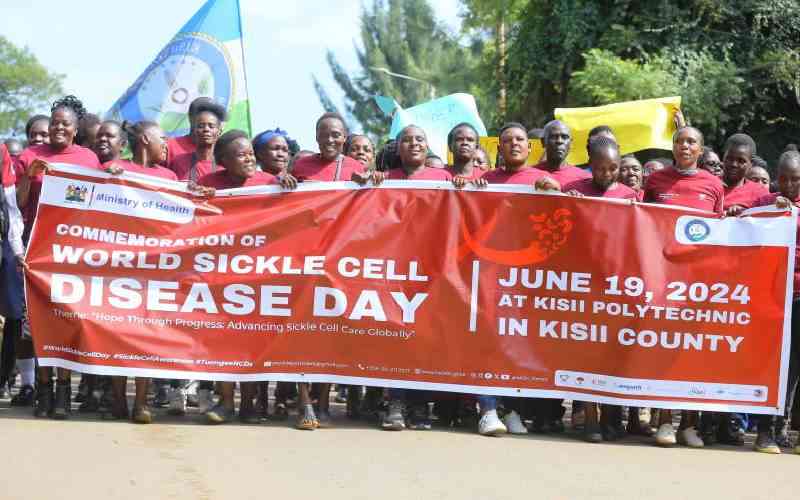
Participants march in Kisii town to mark World Sickle Cell Disease Day. [File, Standard]
Judith Akinyi dreams of giving birth to a girl. But that dream fades each time she watches her older children battle a pain she knows too well.
For the 35-year-old, motherhood has been marked by fear, with much of her life spent in hospital corridors, grappling with unanswered questions.
Akinyi, from Nyagitha village in Homa Bay County, is a mother of four. One of her children lives with sickle cell disease, as do two children from her husband’s first marriage.
“I would love to have a girl,” says Akinyi. “But when I see what my children go through, my heart grows heavy. I fear bringing another child into suffering.”
Despite these fears, she does not know her sickle cell status. On several occasions, she has tried to undergo a DNA test, hoping it would help her make an informed decision about whether to conceive again.
But her husband, Peter Ogutu, 46, appears reluctant, keeping the test out of reach. “Knowing my status would help me decide, Akinyi says. If I am a carrier, I need to understand what that means for my children and for my future.”
Her 46-year-old husband acknowledges his wife’s wish for a daughter, joking that “she is still young.”
However, he has not undergone a DNA test to know his sickle cell status, maintaining that he doesn’t know the cause of the disease.
Since then, his life has been defined by constant suffering. “I honestly do not know much about this disease. Is it tested?” he asks during an interview with The Standard, but agrees with his wife that couples should undergo sickle cell testing before marriage.
Ogutu’s firstborn child from his first marriage, Fidel Castro, 18, bears the most visible toll of the disease.
Diagnosed at just four months old, Castro experienced severe pain, aggravated by even the slightest touch. He later suffered a stroke that left deformities on his limbs, making it difficult for him to walk.
Since then, his life has been marked by constant suffering.
Education disrupted
The condition has disrupted his education, for example while his peers are in Form Three, Castro remains in Grade Seven, a situation that hurts him deeply.
Cold weather often triggers painful joint crises, forcing him to stay home for weeks at a time.
“Joint pain can strike suddenly,” Castro tells The Standard. “I am forced to lie on my desk until my classmates help take me home. When the crisis comes, the pain is everywhere.”
Such experiences have dampened the couple’s desire to have another child.
Ogutu regrets that, although the disease is common in the village, it is often linked to witchcraft, discouraging proper treatment and fuelling shame.
“People told us to go to traditional healers, insisting it cannot be treated by conventional medicine,” Ogutu says.
With limited finances, the family struggles to access quality care.
Ogutu works as a casual labourer, constructing houses in the village and earning about Sh700 a day, but only manages to work two days a week.
With three children on daily medication, the cost is overwhelming.
“My children need up to Sh300 a day for medicine. If I do not work, they miss their medication and face more pain and the risk of serious complications,” the father says.
For Akinyi, ensuring couples know their sickle cell status before marriage could be life-changing. She wants DNA screening to be easily accessible, even before marriage. She also calls on the government to subsidise essential drugs such as Hydroxyurea, which are often unavailable or unaffordable.
Hydroxyurea helps people living with sickle cell disease by increasing protective foetal haemoglobin, reducing painful crises and preventing organ damage.
As for her dream of having a daughter, Akinyi remains uncertain. Stigma surrounding the disease, compounded by misinformation, fuels fear in the community, where many believe that children born with sickle cell disease do not survive beyond 18 years. This fear has long haunted Vallary Natasha, who has just turned 18.
Natasha was diagnosed in Form One after suffering repeated episodes of acute pain and malaria.
“The emotional toll was heavy,” she says. “People told me I would not live past 15. At one point, I believed death was inevitable.” At 18, though physically strong, she remains anxious about her future. She now dreams of becoming a nurse, hoping to one day help find a cure.
Sadly, her mother distances herself from being a sickle cell carrier, insisting it could be linked to witchcraft. She even warned Natasha against blood transfusions despite episodes of anaemia.
The experiences of Akinyi’s family and Natasha reflect the emotional and financial anguish faced by hundreds of couples and children living with sickle cell disease, which is endemic in Homa Bay, Nyanza, Western and Coastal regions.
Michael Ochola, the county Non-Communicable Diseases (NCD) coordinator, notes a growing burden of sickle cell anaemia in Homa Bay.
Cultural stigma
However, the county’s response has yet to match the scale of the problem, largely due to low awareness and deep-rooted cultural stigma.
“Some people still believe sickle cell is a curse. This misconception hinders early detection and diagnosis,” Ochola says. Disputes often arise among couples who are carriers or whose children are affected. Even so, the county lacks adequate reporting tools and enough trained personnel to comprehensively manage the disease.
The official notes that some progress has been made through training healthcare workers and providing subsidised medicines, including Hydroxyurea and antibiotics.
Plans are underway, in collaboration with partners, to establish a sickle cell centre of excellence, with haemoglobin electrophoresis machines distributed across all sub-counties to speed up early diagnosis. At the community level, programmes include premarital counselling and sensitisation campaigns led by Community Health Promoters (CHPs).
“Sickle cell is among the most common diseases in the county, and the numbers are rising. Families need to understand the genetics involved. Just like HIV testing before marriage, sickle cell testing should inform couples about their risk of having affected children,” Ochola says.Currently, two types of tests are conducted—sickling tests and haemoglobin electrophoresis—with confirmatory testing done at Homa Bay Referral Hospital.
Although about 3,000 cases are documented, many more remain undiagnosed due to cultural taboos. Plans are underway to roll out mass community screening to reach both children and adults who might otherwise go undetected.
Ochola emphasises that routine clinic visits and early screening are critical.
“Sickle cell is a killer disease, yet screening is not prioritised. Families hide the condition, and children are often only diagnosed after complications arise,” he says. To improve care, Ochola points to the county’s blood donation initiative, which has established a referral network to ensure timely blood supply.
Amid the financial strain of accessing care, the Facility Improvement Financing (FIF) programme under the Social Health Authority (SHA) will allow sub-county hospitals to procure sickle cell medicines, improving affordability and access through reimbursement.
According to the World Health Organization (WHO), sickle cell disease is a genetic disorder that affects haemoglobin, the protein in red blood cells responsible for carrying oxygen. It causes red blood cells to become rigid and sickle-shaped, leading to blocked blood flow, severe pain and organ damage.
The condition is caused by a mutation in the HBB gene, which provides instructions for making haemoglobin. When a person inherits two copies of the haemoglobin gene (one from each parent), they develop SCD.
Individuals with one normal haemoglobin gene and one abnormal gene have Sickle Cell Trait (SCT) and usually do not exhibit symptoms but can pass the gene to their offspring.
Prevalence
SCD is most common in individuals of African, Mediterranean, Middle Eastern and Indian descent. In Kenya, at least 14,000 babies are born with the disease every year, with Western, Nyanza and Coast being high-burden regions.
Stephen Kimwaki, Mobile Health Activity Manager at Médecins Sans Frontières (MSF) Homa Bay Project, raises concern over the growing burden of NCDs in the region, including diabetes, epilepsy, asthma, hypertension and sickle cell disease. MSF currently supports at least 205 patients with sickle cell directly at Nyalkinyi and Marindi hospitals.
“High burden of sickle cell at the community is worrying. We are working to expand access to care, including treatment at lower-level health facilities, while managing a total of 2,800 patients with different NCDs,” says Kimwaki.
In the two facilities, MSF conducts testing using SickleSCAN kits. Patients who test positive are enrolled in care programmes including malaria prophylaxis, folic acid to boost haemoglobin, vaccinations against pneumonia, meningitis, and influenza, and antibiotics for children under five.
Care also focuses on treatment adherence, balanced diet and proper hydration, since dehydration often triggers sickle cell crises. Other health checks, including haemoglobin levels, complete blood counts, and kidney function, are performed. With proper care, hospitalisations have reduced.
Kimwaki notes key gaps in the management of sickle cell, namely limited early screening, erratic access to medications like Hydroxyurea, low community awareness of sickle cell disease, and inconsistent knowledge among healthcare workers.
“Early screening and treatment can reduce the burden of sickle cell disease,” he says.Kimwaki urges national and county governments to invest in NCD care in Nyanza, including funding for screening and treatment at lower-level facilities to improve outcomes and reduce pressure on major hospitals.
Dr Edith Ogada, a paediatrician at Homa Bay County Teaching and Referral Hospital, emphasises the need for early detection and intervention for the disease in Kenya.
At Homa Bay Hospital, at least 21 out of every 100 children may have sickle cell disease, with many more carrying the trait.“The key to managing sickle cell disease is early screening. Early detection allows timely treatment and significantly improves health outcomes,” says Ogada. Screening at six weeks is especially crucial because it enables healthcare providers to start interventions before severe complications develop.
Unfortunately, in many areas, testing is still limited, and babies are often screened only after presenting with symptoms rather than universally at birth. When a baby is screened, there are three possible results: negative (no trait or disease), trait (carrier), or positive (disease present).
Babies typically start showing symptoms around six months, as protective foetal haemoglobin (HbF) levels decline and adult haemoglobin takes over.
Symptoms include acute pain crises affecting hands, feet, bones, and back. Severe complications include anaemia, jaundice, stroke, and leg ulcers.
Ogada explains that sickle cell disease is inherited. If both parents carry the sickle cell trait, each child has a 25 per cent chance of having SCD, a 50 per cent chance of carrying the trait, and a 25 per cent chance of being unaffected.
“Many people only discover their carrier status after marriage, which is why premarital screening and counselling are critical. Knowing your partner’s status allows informed decisions, similar to HIV testing. While religious or cultural norms may not prevent marriages, awareness is vital to break the chain of transmission,” says Dr Ogada.
At Homa Bay County Teaching and Referral Hospital, screening begins with a SickleSCAN blood test, which provides a rapid indication of the disease.
Positive results are confirmed through haemoglobin electrophoresis.
Historically, only symptomatic children were screened, but with inclusion in Maternal and Child Health (MCH) programmes, every newborn will have an opportunity for early testing, done at six weeks and 12 months.
Sickle cell remains a significant public health challenge in Kenya.
Treatment aims to manage symptoms, prevent complications and improve quality of life. This includes putting a patient on medications such as Hydroxyurea, folic acid supplements and regular follow-up. Bone marrow transplants are the only curative option but remain inaccessible and unaffordable for most patients.
She notes that many complications are preventable with early detection and consistent treatment. Once deformities occur, they are rarely reversible. Dr Ogada advocates for broader community awareness and engagement.
“Breaking the chain of sickle cell transmission requires people to know their status. We must work with religious leaders, elders and communities to promote premarital screening and health education. Prevention is far better than cure,” observes Dr Ogada.
Despite progress, early detection and treatment gaps persist.
Many families lack funds to access medication, leading to preventable hospitalisations and severe complications.
Thankfully, bone marrow treatment is now offered at the Jaramogi Oginga Odinga Teaching and Referral Hospital following acquisition of an apheresis machine with technical support from the Nairobi West Hospital.
Subscribe to our newsletter and stay updated on the latest developments and special offers!